

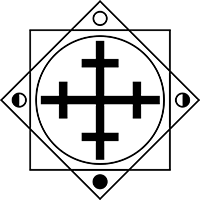
Chiasmus
A grammatical or literary technique in which pairs of words, phrases, or concepts are repeated in reverse order, from the Greek χιάζειν (placing crosswise, a diagonal arrangement); from the 22nd letter of the Greek alphabet, Chi (χ). Chiasmus is an ancient sentence structure in which the pattern reaches a central point and then reverses. The pattern can be summarized by the example: A·B·C·D·C·B·A, where the concept in “A” appears in the first and again in the last sentence. Similarly, concept “B” repeats in the second to the first and second to the last sentence, and so on.1 Examples of chiasm or chiasmus are found throughout literature, ancient as well as contemporary. The use of this literary device in the Book of Mormon wasn’t widely known until its discovery in 1967.2 One of the longest examples of a chiasm in the Book of Mormon is found in [Alma 17]. The entire chapter is a lengthy form of this pattern of writing.3 “Nothing could be more central to the dramatic message of [Alma 17] than its well-defined centerpiece in [verse 4], whose key terms are: Harrowed up / I remembered / Jesus Christ, a son of God / Jesus Christ, thou son of God / I remembered / Harrowed up no more.”4
“Th[is] same [chiastic] pattern appears in the Menorah. The seven lamps have arms which connect the first to the last. If you were to set the lampstand out in the same form using ‘A·B·C’ the pattern would look like: A·B·C·D·C·B·A. The arms of the Menorah are also a chiasm. The first is also the last. The pattern is the same from beginning to middle and from middle to end, the one being a mirror image of the other. So we have a temple article containing, by its form, a symbol which mirrors the ancient word form of chiasmus. The pattern seems to have a meaning. We have a description of the Urim and Thummim from Lucy Mack Smith: ‘Upon examination, [I] found that it consisted of two smooth three-cornered diamonds set in glass, and the glasses were set in silver bows, which were connected with each other in much the same way as old fashioned spectacles.’ One of these ‘two smooth three-cornered’ stones pointed upward. The other pointed downward. This pattern of two triangles pointing in opposite directions is what the Star of David is made from. One pointing up, and the other pointing down. It, too, is a kind of chiasm. Progression and regression set in a side-by-side pattern. The Urim and Thummim is a chiasm. The Star of David was modeled on the Urim and Thummim, and is also a chiasm….Symbol and meaning merge into patterns intended to suggest to the mind a deeper level of meaning. What do we make of these symbols? These imbedded messages seem to return to a theme. Whatever other meanings as may be contained in these forms, patterns and types, it necessarily includes the notion that to go forward you must go backward. Perhaps this meaning reigns supreme over all the other symbolic meanings of the pattern.”5
1 Discoveries in Chiasmus: A Pattern in All Things, ed. Yvonne Bent and Scott L. Vanatter (Digital Legend Press, 2012), Introduction; see also “Discoveries in Chiasmus: A Pattern in All Things,” May, 2012, paper, 4n4.
2 Ibid., 1.
3 Ibid., 4n6. See also Chiasmus in Antiquity, John W. Welch, ed., (Provo: The Foundation for Ancient Research and Mormon Studies, 1981).
4 John W. Welch, “Criteria for Identifying and Evaluating the Presence of Chiasmus,” Journal of Book of Mormon Studies: Vol. 4: No. 2, 1995, Article 1, p. 8. Available at https://scholarsarchive.byu.edu/jbms/vol4/iss2/1.
5 Discoveries in Chiasmus: A Pattern in All Things, Introduction; “Discoveries in Chiasmus: A Pattern in All Things,” May, 2012, paper, 4–5.